Precision gene therapy design, engineered per genome.
EXONIK is a computational platform that designs precision, patient-personalizable gene therapies — from raw genomic data to clinical report. Flagship target: Parkinson's disease (GBA1), a high-impact disease with no approved disease-modifying therapy.
"The same CRISPR guide safe for one patient can be dangerous for another — because their genomes are different."
Parkinson's disease affects around 10 million people worldwide, and as of July 2026 there is no approved disease-modifying therapy — every treatment on the market only manages symptoms. The single largest genetic risk factor is the GBA1 gene, implicated in roughly 5–15% of cases.
GBA1 sits ~16 kb from a pseudogene, GBAP1, with ~96% sequence identity. Any CRISPR guide designed for GBA1 looks almost identical to regions of GBAP1 — a natural minefield of near-identical off-targets. A guide that appears "clean" against the gene alone can, in reality, cut the pseudogene.
This is exactly where EXONIK's engine delivers its differential value: real off-target analysis against the whole genome, plus patient-level SNP personalization.
Sickle Cell Disease is not forgotten — it remains EXONIK's fully validated baseline (5 real patients, full personalization). But Parkinson-GBA1 is where the platform proves it can attack a high-impact disease with no approved cure and genetically hostile terrain.
The Differentiator
What EXONIK sees that a gene-only design misses
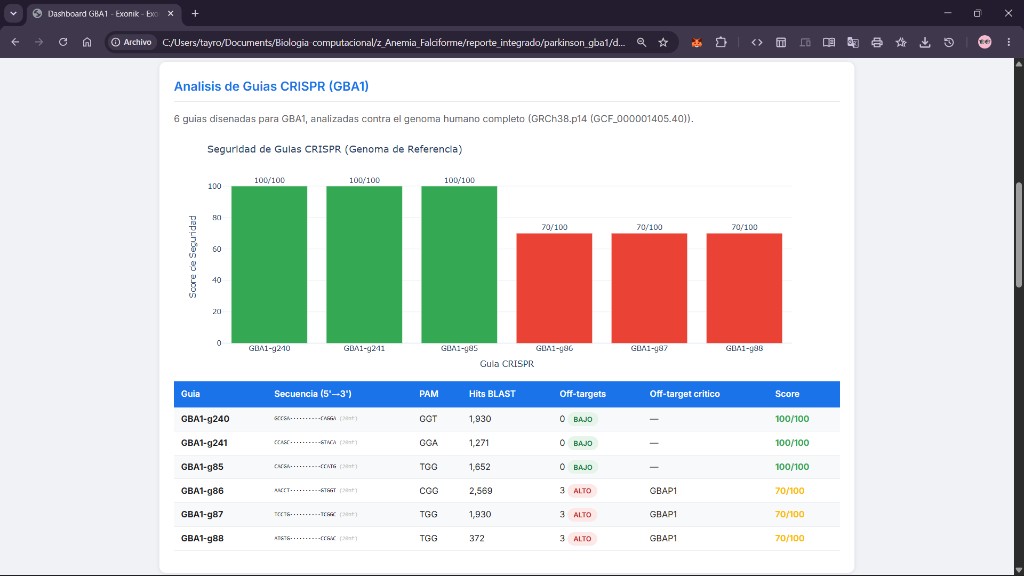
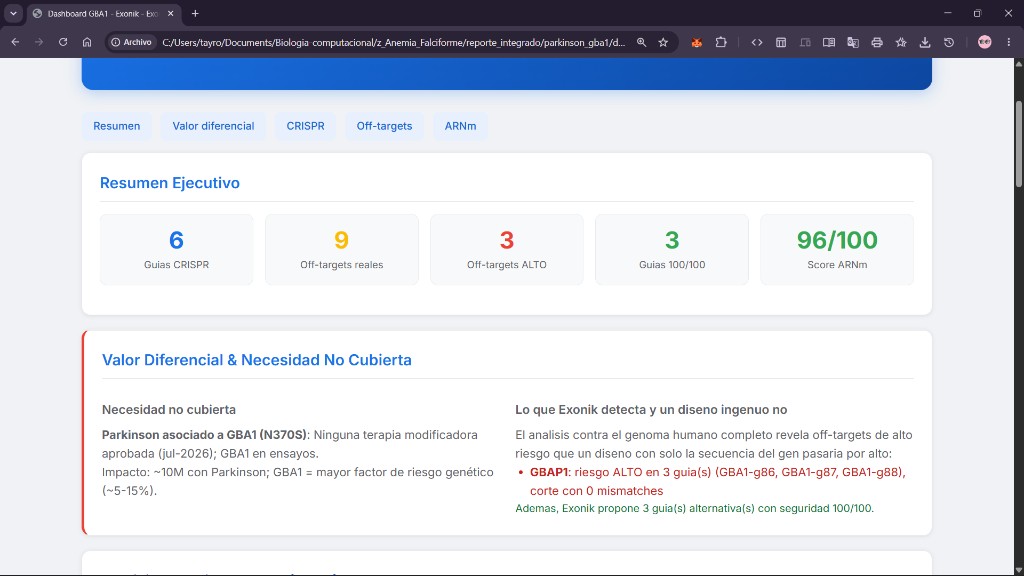
A conventional "design a guide on the gene sequence" approach would ship guides GBA1-g86/g87/g88 as reasonable candidates. EXONIK ran each guide against the entire GRCh38 reference genome and found the hidden danger.
Naive, gene-only design
Guides GBA1-g86 / g87 / g88 look like valid candidates
No visibility into the rest of the genome
Perfect-match (0-mismatch) cut inside the GBAP1 pseudogene goes undetected
Ships a guide that cuts in the wrong place
EXONIK genome-wide screening
Each guide BLASTed against the full human genome (GRCh38)
Per-guide safety scores and the exact GBAP1 off-targets — green guides are ready; red guides are the ones a gene-only design would have shipped by mistake.
Nobody is doing genome-wide, patient-personalized off-target screening at scale for these targets. That is EXONIK's opportunity.
The Platform
One engine, many diseases
EXONIK is disease-agnostic by design. The core logic — CRISPR design, off-target BLAST, mRNA design, dashboards — is shared. Each disease is a self-contained module defined by a standard schema. Switching targets is a single environment variable.
# Run the whole pipeline for a different disease — same engine, no code changes
export EXONIK_DISEASE=parkinson_gba1# or: sca | beta_thal
Disease
Gene
Variant
Role in EXONIK
Parkinson (GBA1)
GBA1
N370S · rs76763715
Flagship Unmet need + GBAP1 differentiator
Sickle Cell Disease
HBB
rs334 · GAG→GTG
Validated baseline 5 real patients, full personalization
Beta-Thalassemia
HBB
β⁺ / β⁰
Modularity proof Same gene, different variant
The same platform validated end-to-end on Sickle Cell was redirected to Parkinson-GBA1 by configuration alone — the strongest possible evidence that EXONIK scales across monogenic and genetically complex targets.
Two layers of intelligence
Precision at the variant — design for the exact disease-causing mutation. Personalization at the patient — adapt the safety profile to each individual genome.
Root cause, not symptom
Where drug discovery patches a misfolded protein at runtime, EXONIK operates at the most upstream point possible — the genome itself — to fix or restore the code that builds the protein.
AI-native architecture
EXONIK treats DNA as a language. Today it already runs deep learning for 3D structure (AlphaFold), and its decoupled, JSON-driven engine is built to plug in transformer-based genomic language models — models that read nucleotide sequences to predict cut sites, binding affinity and gRNA/mRNA efficiency. Deterministic where exactness wins (BLAST, thermodynamics); learned where biology has no closed formula. Predictive ML layer (patient variants + epigenetics): on the roadmap.
Positioning
Gene therapy vs. drug discovery
Both approaches use AI and structural biology. But drug discovery treats the symptom; gene therapy fixes the cause.
Drug discovery (e.g. Isomorphic Labs)
EXONIK (gene therapy)
Target
Protein surface (downstream)
DNA / mRNA (upstream)
Action
Design a molecule to bind / block the protein
Edit the genome / restore the missing protein
Duration
Chronic (repeated dosing)
One-time correction / durable restoration
Personalization
Same drug for all patients
Each patient's genome analyzed
Analogy
Patching a bug at runtime
Fixing the source code
"The best way to fix a bug is not to write a better error handler — it's to fix the line of code that causes it."
Key Results
Evidence, not slides
Flagship Parkinson's disease (GBA1)
Target gene
GBA1 (chr1) — N370S
Approved therapy
None (Jul 2026)
CRISPR guides designed
6 vs full GRCh38
Perfect-safety guides
3 — 0 off-targets, 100/100
HIGH-risk off-targets
3 — all inside GBAP1
Therapeutic mRNA
96/100 (GCasa, 536 aa)
AUG accessibility
100/100
Immunogenicity
Very low (endogenous)
Delivery
LNP → IV, BBB-crossing ligands
Validated baseline Sickle Cell (HBB)
Real patients analyzed
5 (3 continents)
CRISPR guides designed
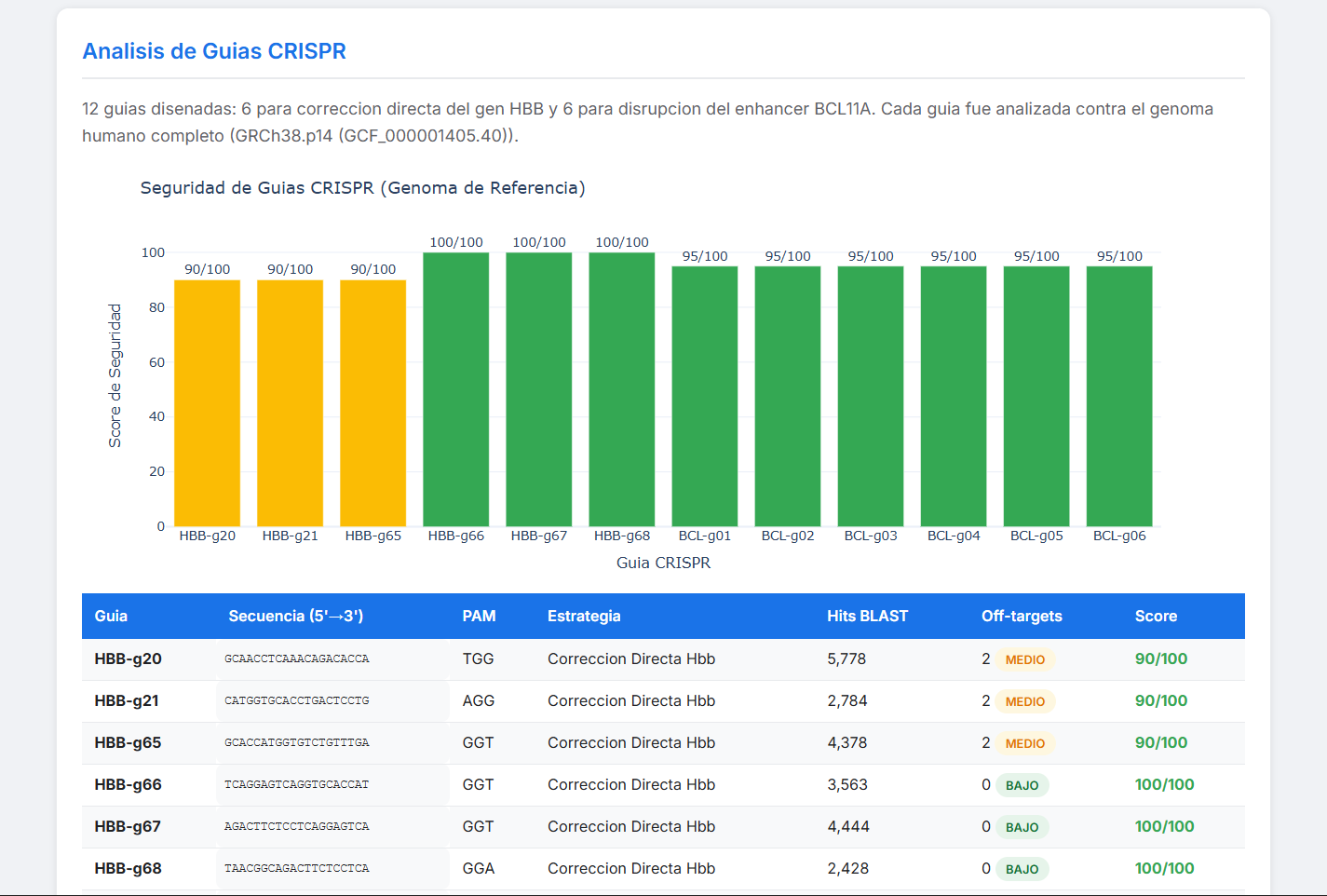
12 (HBB + BCL11A)
Off-targets found (BLAST)
12 (chr2, 11, 14)
Personalization coverage
12/12 × 5 patients
Best guide
HBB-g68 — 100/100
Therapeutic mRNA
96/100
3D visualizations
4 interactive HTML
Cohorts
Nigeria, Gambia, Colombia, PR, Caribbean
Genome-to-atom mapping
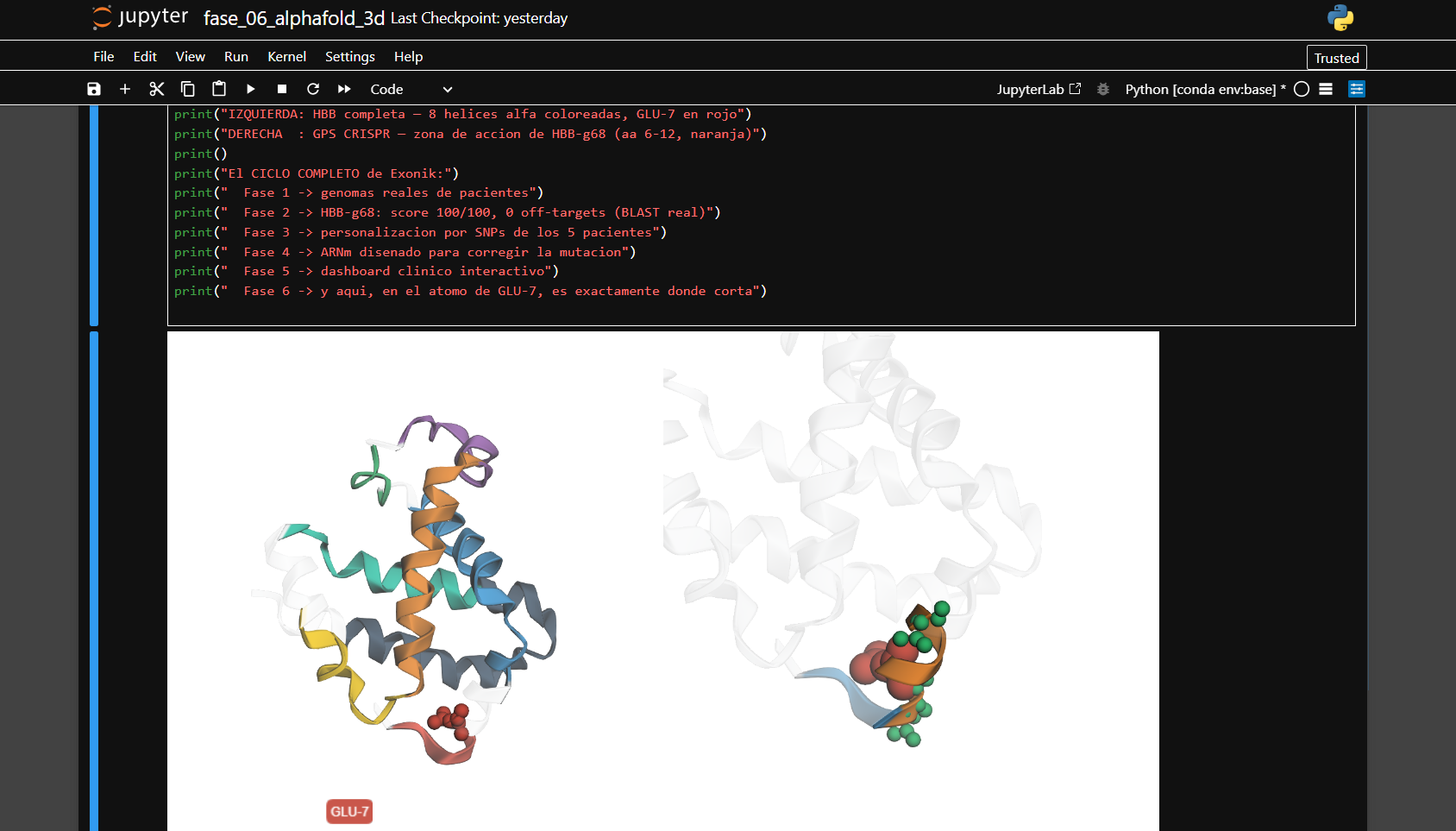
Guide → GLU-7 cut site
Interactive Dashboards
Explore the live evidence
Self-contained, interactive reports — no server required. Open them directly in the browser.
Open interactive 3D
Genome to atom — HBB protein with 8 alpha helices (left) and the GPS-CRISPR view showing exactly where guide HBB-g68 cuts at GLU-7, the Sickle Cell mutation site (right). Rotate and zoom the live molecule in the browser.
Guides designed and BLASTed against the full GRCh38 genome; GBAP1 off-targets detected.
Done
Therapeutic mRNA design
Codon optimization, secondary structure, immunogenicity and stability — 96/100 for functional GCasa.
Done
Modular multi-disease architecture
Disease-agnostic engine; new targets added by configuration.
Next
Patient-level personalization for Parkinson
Cross the GBAP1 off-targets with each patient's real SNPs — "is this guide safe for this genome?"
Next
GBA1 3D + GPS-CRISPR
GCasa structure (AlphaFold, UniProt P04062) with the N370S site highlighted.
Future
Genomic language models & agentic layer
Transformer-based models that read DNA as language to predict cut efficiency and off-target risk per patient, plus agents that learn gene interactions in polygenic disease — served at scale.
Where EXONIK fits today
Gene-addition (AAV) leads on delivery. EXONIK is the design-and-safety layer that sits on top of any modality — it designs the optimized therapeutic sequence and, critically, catches the near-identical off-targets (like GBAP1) that a gene-only approach would miss.
Delivery & efficacy — honest framing
All designs are computational (in silico) and require experimental validation. mRNA offers fast proof-of-concept but transient expression; durable CNS restoration likely favors AAV — a transgene EXONIK also designs. Delivery across the blood-brain barrier remains the central challenge.
Phases 2, 3, 4 and the 3D notebook contain proprietary algorithms (core IP) and are available to research partners under NDA. The public disease modules contain only public reference sequences (NCBI / dbSNP) and the modular architecture — intentionally shown to demonstrate the platform design.